
Prophetic Feed
Browse recent prophetic words and updates from the community.
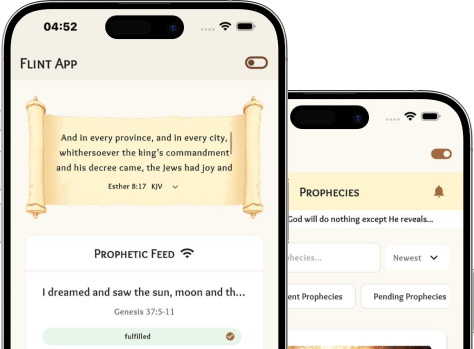
Browse recent prophetic words and updates from the community.
Highlight key prophetic moments and featured messages.
Explore mysteries and deeper insights into realities of life.
The prophecy in Genesis 15:13-16 emerges from the Abrahamic covenant narratives, where God begins forming a people through whom blessing will reach the nations. It looks toward the outcome that Abraham's descendants shall be oppressed and later delivered. The passage therefore explains not only what was expected to happen, but what that future meant to the people first living through the story. The movement toward fulfilment is associated with observable conditions such as abraham's descendants living outside the promised land, their multiplication, captivity, increasing oppression, God's judgment upon the oppressing nation, the fourth generation approaching. These details help readers follow the passage's own logic without treating every modern resemblance as a fulfilment. The later biblical record presents the central prediction as fulfilled. Exodus records Israel's oppression, departure with possessions and journey toward the land, Acts 7 also repeats the prediction and its biblical fulfilment. The wider prophetic perspective is that God's purposes unfold through real people, decisions and historical pressures rather than through abstract promises alone. Faith does not remove human responsibility, rather it teaches people to recognise God's direction, obey within their own sphere and steward a good outcome without presumption. A present-day reflection For believers today, the prophecy calls for active trust rather than passive admiration. The response is to preserve covenant identity during hardship, cry to God for deliverance, refuse assimilation into oppression, and prepare to move when God opens the way. Trust is expressed through patient obedience, wise preparation and a life that remains aligned with God before, during and after the promised outcome.
Following God's convenant with Noah, Noah blessed the descendants of his sons Japheth, Shem, and Ham according to their actions. He declared that the descendants of Canaan (son of Ham, Genesis 9:22), Shem and Japheth shall have different futures. Canaan was cursed because his father, Ham, saw his fathers nakedness and did nothing about it, while his brothers covered their fathers nakedness. The movement toward fulfilment is associated with observable conditions such as the growth of the three family lines into peoples and nations, conflict involving Canaanite peoples, the enlargement of Japheth's descendants. The fulfilment is best understood in stages, a series of events, rather than as a single event. Genesis 10 traces the peoples associated with Noah's sons and later biblical history records Israel's conflict with Canaanite nations. What has already occurred gives substance to the prophecy, while its complete scope should not be claimed where Scripture or history still points beyond the present fulfilment. The larger prophetic principle is that power, leadership and communities remain accountable to God. Delay is not approval, and visible strength cannot permanently protect violence, idolatry, pride or injustice from consequence. This is also a warning to generations to use the right moral lens to examine their own use of power. A present-day reflection: The present-day reflection is sobering. Although Ham made the mistake, the consequence was passed down on his descendants. Delayed consequence must not be mistaken for divine approval. As christians we ought reject contempt and dishonour within families, cultivate righteousness across generations, and avoid using this passage to justify racial oppression. Even though this prophecy describes an unconditional event, preparation and faithfulness matter even when the event itself cannot be cancelled.
God appeared to Jacob in a dream and blessed him and his descendants saying, "...the land whereon thou liest, to thee will I give it, and to thy seed: and thy seed shall be as the dust of the earth, and thou shalt spread abroad to the west and to the east, and to the North, and to the south: and in thee and in thy seed shall all the families of the earth be blessed. And behold I am with thee, and will keep thee in all places wither thou goest, and will bring thee again into this land; for I will not leave thee, until I have done that which I have spoken to thee of." Genesis 28:12-15. God not only blessed him, He gave him the land ans his inheritance and promised to be with him until the prophecy is fulfilled. God also confirmed that the promise He made to Abraham will be fulfilled through him. The movement toward fulfilment is associated with observable conditions such as Jacob's preservation in exile, the formation of his large household through two wives and two handmaids unlike father and grandfather, the return to Canaan from Egypt, growth of the tribes of Israel, blessing extending beyond the family. Israel's later national history reflects the promise, while its worldwide dimension is treated as ongoing in Christian interpretation. This prophecy is a proof that God's purposes unfold through real people, decisions and historical pressures rather than through abstract promises alone. Faith does not remove human responsibility; it teaches people to recognise God's direction, obey within their own sphere and steward a good outcome without presumption. A present-day reflection For believers today, the prophecy calls for active trust rather than passive admiration. The response is to consecrate your journey to God, walk in covenant faithfulness, trust His presence during displacement and return obediently when He directs. Trust is expressed through patient obedience, wise preparation and a life that remains aligned with God before, during and after the promised outcome.
God spoke to Rebekah during a difficult pregnancy, declaring, “Two nations are in thy womb, and two manner of people shall be separated from thy bowels... and the elder shall serve the younger” (Genesis 25:23). As the children struggled within her, Rebekah did not rely on her own understanding but went to enquire of the Lord. God revealed that what she carried was far greater than two unborn children. It was the beginning of two nations and the unfolding of His covenant purpose through Jacob rather than Esau. The prophecy unfolded exactly as God had spoken. Jacob and Esau were born with contrasting destinies, and over time they became the fathers of Israel and Edom. What seemed like an ordinary pregnancy was actually carrying a future that would shape generations. The struggle within Rebekah was not meaningless; it reflected the significance of what God had placed inside her. Before either child had done good or evil, God declared His sovereign purpose, showing that His plans are established by His calling and not by human expectations alone. The account also teaches the importance of seeking God rather than manipulating His promises. Although God's word was certain, later attempts by Rebekah and Jacob to force its fulfilment brought unnecessary pain and division. God's purposes never require human deception to succeed; He is fully able to accomplish what He has spoken in His own time and way. A present-day reflection: This passage reminds believers that God often places purposes, callings, and visions within His people long before they become visible. Like Rebekah, we may experience seasons of inward struggle as God forms what He intends to bring forth. The answer is not frustration or human striving, but to seek the Lord in prayer, receive His wisdom, and faithfully carry what He has entrusted to us. Every God-given vision has an appointed time. Our responsibility is to nurture it through obedience, perseverance, and prayer until it is brought to birth, resisting the temptation to force what only God can fulfil.
Jesus gave a solemn warning to His disciples, saying simply, “Remember Lot's wife” (Luke 17:32). He spoke these words while teaching about His return, pointing back to the destruction of Sodom and Gomorrah as an example of how suddenly God's judgment can come. In the days of Lot, life continued as normal until God sent messengers to warn Lot to flee the city. The instruction was urgent: leave immediately and do not look back. Yet Lot's wife looked back longingly toward what God was judging and became a lasting example of disobedience. The destruction of Sodom fulfilled exactly what God had declared. Despite Abraham's intercession, the city's persistent wickedness reached its full measure, and judgment came. Yet in the midst of judgment, God remembered His mercy, delivering Lot and his household before the city was destroyed. The account reveals both God's justice against unrepentant evil and His faithfulness to preserve those who respond to His warning. Jesus deliberately brought this historical event into the context of the last days. Just as people in Sodom continued with ordinary life until judgment came, He warned that His return would likewise come unexpectedly. His command to "Remember Lot's wife" is therefore more than a reference to the past—it is a call to wholehearted obedience, urging His followers not to cling to a world from which God is calling them to depart. A present-day reflection: Jesus' warning remains deeply relevant today. As the world moves further from God's ways, believers are called to separate themselves from persistent wickedness and respond promptly to God's voice. The lesson is not merely to leave places of judgment, but to leave behind every attachment that competes with obedience to God and His word. Like Noah's generation and Lot's family, we are called to live with readiness, refusing to look back, and pressing forward toward the salvation and kingdom that God has prepared.
God said to Abraham concerning Sarah, “I will bless her, and give thee a son also of her... she shall be a mother of nations; kings of people shall be of her” (Genesis 17:16). Though both Abraham and Sarah were advanced in age and far beyond the natural ability to have children, God declared that His covenant would be established through the son He Himself had promised. He even appointed the time, saying that Sarah would bear Isaac within the following year, demonstrating that God's promises are governed by His timing, not human possibility. The prophecy unfolded exactly as God had spoken. Despite the impossibility of the circumstances, Sarah conceived and gave birth to Isaac at the appointed time (Genesis 21:1–7). What seemed impossible by human reasoning became undeniable evidence that God is faithful to fulfill every word He speaks. Isaac's birth was not merely the answer to a family's longing, but the continuation of the covenant through which God would raise a nation and ultimately bring blessing to all the families of the earth. This promise also teaches an important lesson about waiting on God. Before Isaac's birth, Abraham and Sarah attempted to fulfil God's promise through human effort with Hagar and Ishmael. Yet God made it clear that His covenant would come through the son He had promised, not through human schemes. The fulfilment therefore reveals both God's faithfulness and the importance of trusting His appointed way. A present-day reflection: This passage reminds believers that God's promises are not limited by human circumstances or natural impossibilities. The call is to trust His word, remain patient in seasons of waiting, and resist the temptation to manufacture what God has promised to provide. When God speaks, He also supplies the power, the timing, and the means to bring His promise to pass.
Our dedicated support team is available to assist you with any inquiries or issues you may have. Feel free to contact us.